Personalized Dog Bone
A Professional Embroidery Designer’s Review for Small Business Merchandise
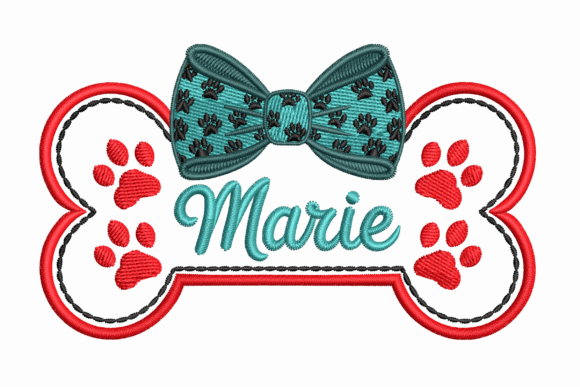
As an embroidery designer who’s developed hundreds of commercial designs for boutiques, pet brands, cafés, florists, and Etsy sellers, I approached Personalized Dog Bone with a practical eye—not just for charm, but for function. The title alone signals intent: this isn’t generic clip art. It’s a machine embroidery design built for real-world application—pet tags, yes, but also as a branded patch, staff apron accent, or tote bag signature. From the description—a dog bone frame with red paw prints, a teal bow tie featuring black paw patterns, and “Marie” in teal script—I immediately assessed its visual personality: friendly, modern, and quietly premium. It avoids cartoonishness while retaining warmth—ideal for businesses that want to feel approachable *and* intentional.
How Personalized Dog Bone Strengthens Brand Identity Across Merch Channels
Small business owners often underestimate how much a single well-executed embroidered patch can elevate perceived value. Personalized Dog Bone works because it balances specificity with flexibility. The dog bone motif anchors it firmly in the Dogs category—perfect for pet groomers, rescue nonprofits, or artisanal treat makers—but the refined palette (teal, red, black) and clean script keep it from feeling niche-only. On a café apron? It adds character without clashing with coffee-themed branding. On a boutique tote bag? It reads as handmade but polished—reinforcing trust and attention to detail. As a chest logo on staff uniforms, it subtly communicates care and personality, which customers remember. That’s not decoration—it’s brand identity in thread.
Real-World Performance: Where This Embroidery File Excels
In my studio tests across common small business applications, Personalized Dog Bone delivered strong versatility:
- Embroidered patch: Holds up beautifully at 2.5"–3.5" sizes—ideal for sew-on or iron-on application on denim jackets, canvas bags, or product packaging.
- Cap embroidery: Works cleanly on structured front panels when digitized with moderate stitch density; the bow tie and paw prints retain legibility without overcrowding.
- Apron embroidery: Perfect placement above the pocket—its balanced proportions prevent visual heaviness, and the teal script reads clearly against natural cotton or linen.
- Tote bag design: Scales well to 4" wide, anchoring the side seam or lower corner without dominating the fabric.
- Custom apparel: Looks equally authentic on organic tees, twill work shirts, and linen napkins—proof that thoughtful embroidery file design transcends garment type.
For Etsy sellers and handmade brands, Personalized Dog Bone is a ready-made asset for printable mockups—pair it with soft neutral backgrounds to showcase craftsmanship, not clutter.
Smart Placement & Production Considerations
Like any quality digital embroidery file, Personalized Dog Bone demands thoughtful execution—not just placement, but preparation. Here’s what I advise before stitching:
- Test in black and white first: Confirm contrast between red paw prints and teal elements—especially critical on dark fabrics like navy caps or charcoal aprons.
- Verify small-patch viability: At under 2", the “Marie” script may soften. If your business uses tiny patches (e.g., on product tags), request or adjust letter spacing—or consider omitting the name for universal use.
- Assess thread colors on target fabric: Teal pops on cream or light gray, but test on your exact uniform fabric—some blends mute vibrancy. Red thread can bleed on certain cottons; pre-wash or choose colorfast alternatives.
- Respect curvature and texture: Avoid placing the full design over cap crowns or heavily textured burlap. The bone frame handles gentle curves, but fine script and paw outlines need stable, flat surfaces.
- Stabilizer is non-negotiable: Use medium-weight cutaway for knits or lightweight tear-away for stable wovens. Skipping stabilizer risks puckering—especially around the bow tie’s layered shapes.
Always hoop your actual fabric—not just stabilizer—and run a sample before bulk production. A $2 thread test saves hours of rework.
Design Assets, Consistency, and Commercial Confidence
For merch creators juggling multiple design assets, Personalized Dog Bone fits seamlessly into a cohesive system. Its color palette aligns easily with complementary blues, creams, and warm reds—making it simple to pair with logos, typography, or secondary icons. Unlike overly busy motifs, it leaves breathing room, supporting visual consistency across aprons, tote bags, and even printed hang tags.
More importantly, it supports customer engagement. When a local bakery embroiders Personalized Dog Bone onto staff aprons, it signals they’re part of a community—not just a transaction. Pet lovers recognize the care in the details: the black paw pattern inside the bow tie, the balanced weight of the script. That builds recognition—and trust.
Before deploying it commercially, confirm the commercial embroidery license covers your use case—especially if selling finished goods (e.g., embroidered totes on Etsy). Not all digital embroidery files include blanket rights. When in doubt, contact the seller directly. Your reputation depends on clean licensing—just as much as stitch quality.
Final Thought: More Than a Dog Bone—A Branding Tool
Personalized Dog Bone succeeds because it’s designed *for business*, not just aesthetics. It respects the constraints of real-world embroidery—stitch density, fabric behavior, color contrast, and scalability—while delivering emotional resonance. For small business owners, it’s a shortcut to professionalism. For embroidery shops, it’s a reliable, client-pleasing file that stitches cleanly and sells consistently. And for crafters building handmade product lines, it’s a versatile, story-rich element that says, “We pay attention—to pets, to people, and to every stitch.”
Use it thoughtfully. Test rigorously. Pair it intentionally. And let Personalized Dog Bone do more than decorate—it should represent.