Santa Approved
First Impression: Bold, Festive, and Playfully Premium
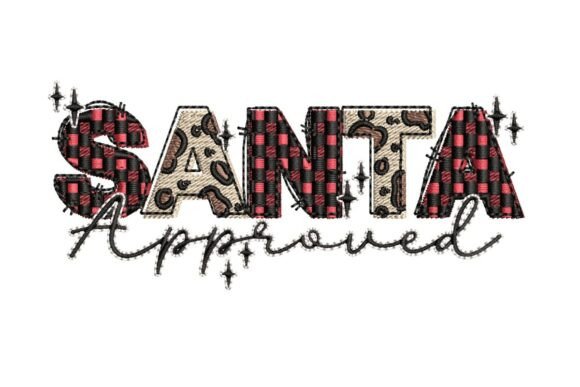
As an embroidery designer who’s prepped over 200 craft fair booths, my gut reaction to Santa Approved is immediate: this isn’t just festive—it’s *attention-grabbing* in the best possible way. The title alone delivers instant holiday recognition, while the description—“bold text filled with contrasting red plaid and leopard print textures, accented by a flowing script”—signals visual energy and intentional contrast. It leans modern-festive rather than traditional or rustic: think curated handmade boutique, not vintage farmhouse. That duality makes it unusually versatile for buyers who want Christmas cheer without cliché.
Where Santa Approved Shines on Craft Fair Products
In a crowded market aisle, Santa Approved performs strongest where typography dominates and texture enhances—not competes. Here’s how it lands across real products I’ll be stitching for this season’s booth:
- Tote bags: Ideal as a large, centered chest design. The bold lettering reads clearly from 6 feet away, and the red plaid/leopard fill adds dimension that photographs beautifully under booth lighting.
- Aprons: Works exceptionally well above the pocket or across the bib. The flowing script softens the boldness, making it feel personal—not corporate—and reinforces handmade charm.
- Tea towels: A standout when placed diagonally across the corner. Fabric texture (like linen or waffle weave) actually complements the layered print textures—just avoid overly thick terry weaves where stitch definition blurs.
- Embroidered patches: Highly effective at 3–4” wide. The contrast between red plaid and leopard ensures legibility even when sewn onto denim jackets or canvas backpacks.
- Caps & curved surfaces: Use caution. The flowing script and tight letter spacing may distort on low-profile caps unless digitized with stretch compensation. Test first on scrap fabric with your exact cap style.
- Pillow covers & small pouches: Best at 4.5–5.5” width. Smaller sizes risk losing texture clarity—especially the leopard detail—so prioritize medium-scale applications over tiny accents.
What Makes Santa Approved Sell—Beyond the Sparkle
This isn’t just a cute Christmas design—it’s a *commercially intelligent* one. Customers at craft fairs don’t pause for subtlety; they respond to confidence, clarity, and charm. Santa Approved delivers all three. Its strong typographic foundation means it reads instantly—even on a phone screen in an Etsy listing. That translates directly to higher click-throughs and faster decision-making at the booth. Because it balances humor (“Santa Approved”) with premium execution (textured fills, deliberate contrast), it elevates perceived value without demanding premium pricing.
For Etsy sellers and small shop owners, Santa Approved also supports brand consistency. Pair it with neutral backdrops (cream linen, charcoal cotton, natural canvas) and it becomes a signature seasonal motif—not just decoration. On display tables, one well-executed Santa Approved apron next to matching tea towels and a patch sampler creates visual rhythm and tells a cohesive story: thoughtful, joyful, and expertly made.
Production Reality Checks Every Embroidery Designer Should Make
Before loading your machine, treat Santa Approved like any high-visibility machine embroidery design: test, verify, refine. Here’s what I do before batch production:
- Run a test on scrap fabric matching your final product (e.g., unbleached canvas for tote bags, brushed twill for aprons).
- Check thread contrast—especially on dark fabrics. Red plaid against navy or black can mute if thread sheen or density isn’t balanced.
- Review spacing between letters and script flow. Tight kerning looks sharp on screen but may nestle poorly on textured towels or curved seams.
- Confirm hoop size compatibility. If the design pushes 5x7”, double-check whether your most-used hoops (and those of your wholesale partners) support it comfortably.
- Inspect stitch density in the plaid and leopard zones. Overly dense fills increase run time and risk puckering on lightweight fabrics—opt for stabilizer that matches both fabric weight *and* design density.
- Create at least one physical mockup—not just a printable mockup. Lighting, drape, and hand-feel change everything.
- Compare how Santa Approved looks on multiple fabric colors. What pops on ivory may disappear on oatmeal; what reads cleanly on cotton duck may blur on terry cloth.
- Verify commercial licensing status. If you’re selling finished products (not just the embroidery file), confirm the digital embroidery file permits commercial embroidery use—no assumptions.
Careful-Use Notes for Maximum Clarity
Santa Approved thrives on contrast and scale—but it has boundaries. Avoid using it:
- Below 3” wide—tiny lettering and intricate texture lose definition, especially on dark or napped fabrics.
- On ultra-thick materials (like heavy-duty canvas or quilted insulation) without adjusting underlay or stabilizer layers.
- Across severe curves (e.g., baseball cap front panels) without testing distortion—script elements are especially vulnerable.
- As a secondary accent next to other busy designs; its personality demands breathing room.
- Without confirming thread color accuracy. “Red plaid” implies specific reds—don’t substitute generic scarlet if your brand uses true cranberry or cherry.
Final Thought: A Design That Sells Itself—If You Let It Breathe
Santa Approved isn’t background holiday decor. It’s a conversation starter, a gift-ready statement, and a reliable craft fair product anchor—all wrapped in one machine embroidery design. When stitched thoughtfully on the right fabric, at the right scale, with the right stabilizer and thread, it communicates joy, craftsmanship, and confidence in under two seconds. For embroidery business owners building a seasonal collection—or Etsy sellers refreshing their Christmas lineup—it’s not just another design. It’s a strategic asset. Just remember: let it shine solo, test fearlessly, and never skip the real-world mockup. Your booth—and your bottom line—will thank you.