Let the Good Times Roll
A Practical Embroidery Designer’s Review for Small Business Merch
As an embroidery designer who’s digitized and stitched over 1,200 small business projects—from neighborhood bakeries to indie florists—I approach every new machine embroidery design with two questions: “Will it hold up in production?” and “Does it strengthen brand identity—not just decorate?” That’s why Let the Good Times Roll caught my attention immediately. Its title alone signals warmth, energy, and approachability—qualities small businesses desperately need in today’s crowded marketplace.
First Impression: Friendly, Sunlit, and Professionally Handmade
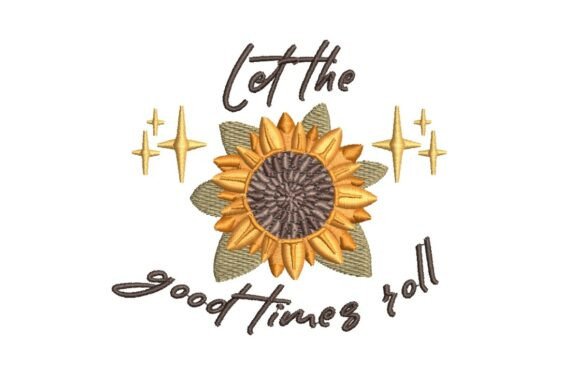
Reading the description—“🌻 Let The Good Times Roll Sunflower Embroidery Design ✨ Spread sunshine and good cheer…”—I instantly pictured a sunflower as both motif and metaphor: bold center, open face, organic texture. The phrase Let the Good Times Roll leans into the Inspirational category without veering into cliché, thanks to its rhythmic cadence and implied movement. Visually, this isn’t a stiff script or minimalist sans-serif—it suggests hand-drawn charm, layered petal detail, and intentional texture. That translates well for brands that want to feel human-scaled, joyful, and grounded—not corporate, not generic.
Where It Shines in Real Business Use
Let the Good Times Roll works exceptionally well across high-impact, low-footprint applications:
- Embroidered patch: Perfect for sew-on or iron-on application on tote bags, denim jackets, or staff aprons. Its central sunflower anchors the composition, while the curved phrase wraps naturally around it—ideal for circular or oval patch formats.
- Apron embroidery: Positioned above the pocket or centered on the chest, it adds personality without overwhelming utility. The sunflower reads clearly at 3–4 inches wide, and the phrase remains legible even with moderate stitch density.
- Cap embroidery: On structured front panels (especially cotton twill or performance blends), the design holds clarity when digitized with clean satin-stitch outlines and balanced letter spacing. Avoid ultra-low-profile caps unless the file includes a simplified version.
- Tote bag design: As a single focal point on natural canvas or unbleached cotton, Let the Good Times Roll elevates perceived value—customers associate thoughtful embroidery with craftsmanship, not mass production.
- Staff uniforms & boutique merchandise: When repeated across shirts, hats, and reusable packaging accents, it builds visual consistency without monotony—especially when paired with complementary icons (e.g., coffee cup, floral sprig, paw print) in your broader design assets.
Where to Use It Thoughtfully
Even strong designs have boundaries—and recognizing them early saves time, thread, and client trust. With Let the Good Times Roll, here’s where caution is warranted:
- Small patch sizes under 2 inches: The sunflower’s texture and phrase curvature may lose definition. Always test the digital embroidery file at actual size before cutting production runs.
- Curved surfaces like cap backs or tapered sleeves: Digitizing must account for fabric stretch and hoop tension. A skilled digitizer will adjust pull compensation and underlay—but don’t assume the base file handles this automatically.
- Dark uniforms or textured fabric: High-contrast thread colors (e.g., lemon yellow on navy, ivory on charcoal) are essential. Avoid light gold or pale yellow on black—it’ll vanish after one wash.
- Frequent-wash items: Check stitch density. Overly dense fills increase stiffness and wear. If the sunflower uses heavy fill stitches, request a lighter-density variant for aprons or kids’ apparel.
Brand Identity Impact: More Than Just a Smile
For a small café, handmade shop, or local florist, Let the Good Times Roll does more than say “we’re nice.” It signals intentionality. Customers subconsciously register embroidered branding as higher-value—especially when the embroidered patch feels cohesive with packaging, signage, and social visuals. Used consistently, it builds recognition faster than printed logos alone. And because it’s rooted in warmth—not urgency or scarcity—it supports long-term trust. I’ve seen clients report increased repeat visits and photo-tagging on Instagram simply because their staff’s aprons featured a design like this: memorable, shareable, authentically them.
Practical Notes Every Embroidery Designer Should Run Through
Before stitching Let the Good Times Roll for commercial use, run these checks:
- Test in black and white first: Print a grayscale mockup to assess contrast, spacing, and silhouette—no color distractions.
- Verify small-size legibility: Resize the design to 2.5” width and check if all letters remain distinct and evenly spaced.
- Review thread color contrast on your target fabric swatch—not just on screen.
- Inspect spacing between sunflower and text: Tight kerning can cause thread nesting; generous spacing improves stability.
- Confirm hoop size compatibility: Does the widest version fit your standard 4x4 or 5x7 hoop? If not, plan for re-hooping or multi-position stitching.
- Test on real fabric + stabilizer: A cotton-linen blend behaves differently than poly-cotton. Use the same stabilizer you’ll use in production.
- Create a printable mockup for client approval—include scale, placement, and thread colors.
- Compare beside existing design assets: Does it harmonize with your logo, icon set, and typography—or clash tonally?
- Confirm commercial licensing: Since this is intended for small business merch, custom apparel, and commercial embroidery, verify usage rights cover resale, distribution, and branded product labeling.
Finally—don’t skip texture testing. The description mentions “beautifully textur[ed]” elements. That likely means varied stitch types (satin, fill, seed, stem) to mimic petal depth and sunflower grain. Those details elevate handmade product perception but require precise stabilizer pairing. A tear-away alone won’t cut it on knits or loosely woven canvas.
Bottom line? Let the Good Times Roll isn’t just cheerful—it’s commercially intelligent. When applied with intention, it transforms everyday items—aprons, caps, totes—into brand ambassadors. For small business owners and embroidery professionals alike, that’s not decoration. It’s strategy, stitched.